This gallery wall guide covers everything you need to plan, size, space and style a gallery wall in 2026 – from your first frame to a full accent wall. There is a moment in every home styling project where a blank wall stops you cold.
You know it needs something. You have Pinterest boards full of inspiration. But when it comes to actually doing it – choosing the right sizes, figuring out how far apart the frames go, deciding which styles work together – most people freeze, guess, and end up with something that does not look quite right.
This guide fixes all of that. It covers everything you need to create a gallery wall that looks intentional rather than accidental: how to choose the right art size for any wall, how to space frames correctly, which styles are trending in 2026, and how to mix prints and frames without it looking chaotic.
And before you buy a single frame or put a single nail in the wall, there is a free tool that lets you visualize exactly how your art will look in your actual space.
Why Gallery Walls Go Wrong (And How to Get Them Right)
The most common gallery wall mistakes are not about taste. They are about proportion, spacing, and planning. Specifically:
- Art that is too small for the wall – the single most common mistake. A piece that looks large in a shop looks tiny on a full wall.
- Inconsistent spacing – frames placed at different distances from each other create visual chaos
- Hanging too high – most people hang art 6 to 10 inches too high. The correct center height is 57 to 60 inches from the floor, which is average eye level
- No unifying element – a gallery wall needs at least one common thread (frame color, mat color, subject matter, or color palette) to feel cohesive
- Not planning the layout before hanging – arranging frames on the wall by trial and error leaves unnecessary holes
How to Use This Gallery Wall Guide
Every section of this guide addresses one of these. By the end, you will have a clear system for planning and executing a gallery wall that works the first time.
Step 1: Choose the Right Art Size for Your Wall
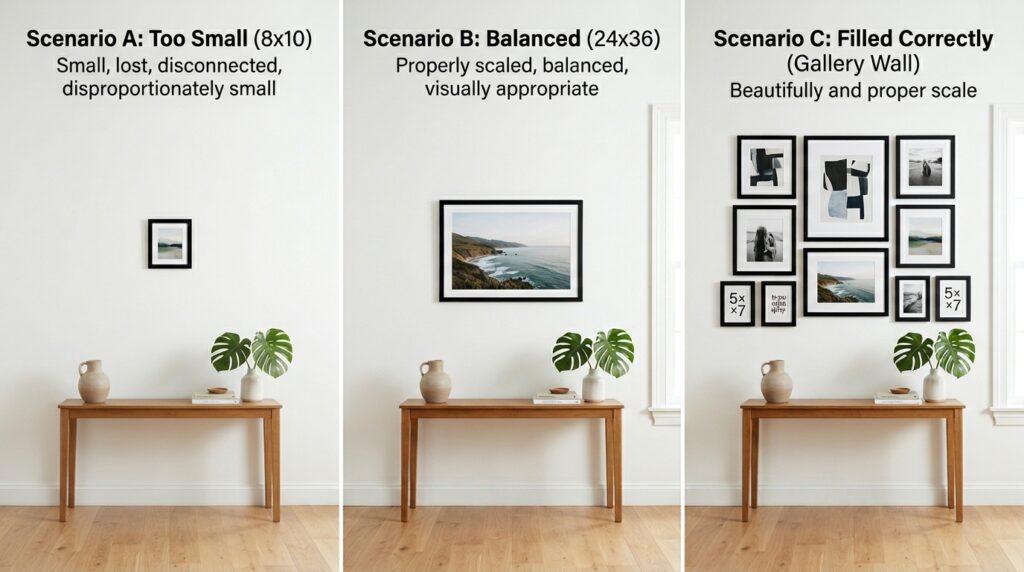
Getting the size right is the foundation of everything else. Use these rules as your starting point:
Art Size by Wall Width
| Wall Width | Recommended Art Width |
|---|---|
| Up to 24 inches (narrow nook or hallway) | 12 to 18 inches |
| 24 to 48 inches (above a console or desk) | 18 to 30 inches |
| 48 to 72 inches (above a sofa or bed) | 30 to 48 inches or a grouping |
| 72 inches and wider (large feature wall) | 48 inches+ or gallery arrangement |
The 57 to 75 Percent Rule
The art or grouping should cover 57 to 75 percent of the wall width it hangs on. If your sofa is 84 inches wide, your art or gallery arrangement should be 48 to 63 inches wide. Anything narrower will look undersized regardless of how beautiful the piece is.
Above Furniture Specific Rules
- Above a sofa: Leave 6 to 8 inches between the top of the sofa and the bottom of the lowest frame
- Above a bed: Leave 4 to 6 inches between the headboard and the bottom of the lowest frame
- Above a console or sideboard: Leave 4 to 8 inches between the furniture top and the bottom frame
Not sure what size works in your exact space? Use the Free Wall Art Size Visualizer to see different art sizes on your actual wall before committing to a purchase or print.
Step 2: Plan Your Gallery Wall Layout
There are six main gallery wall layouts that work consistently well. Choose one based on your wall shape, the number of pieces you have, and the aesthetic you want.
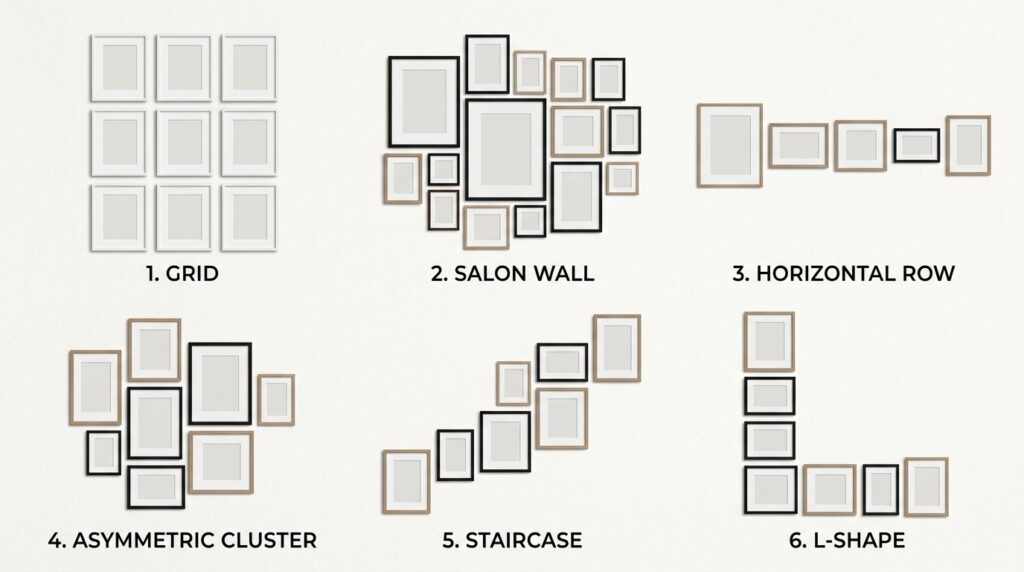
The 6 Gallery Wall Layouts
1. Grid
Equal-sized frames in a symmetrical rows-and-columns arrangement. Best for: minimalist and Scandi styles. Requires precise measuring and level hanging. Works best with 4, 6, or 9 frames.
2. Salon Wall
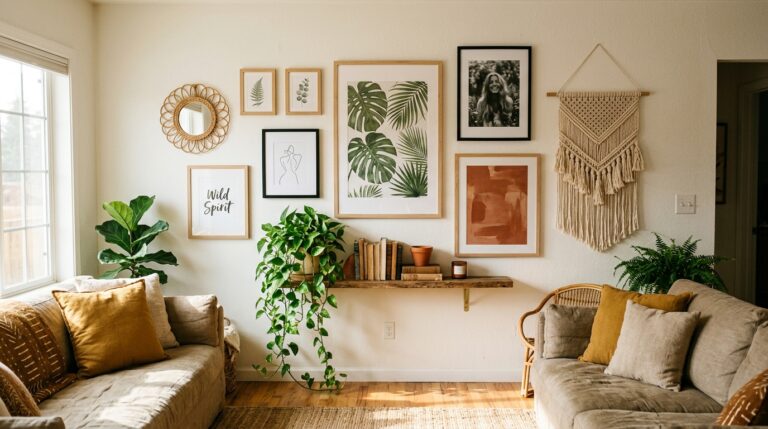
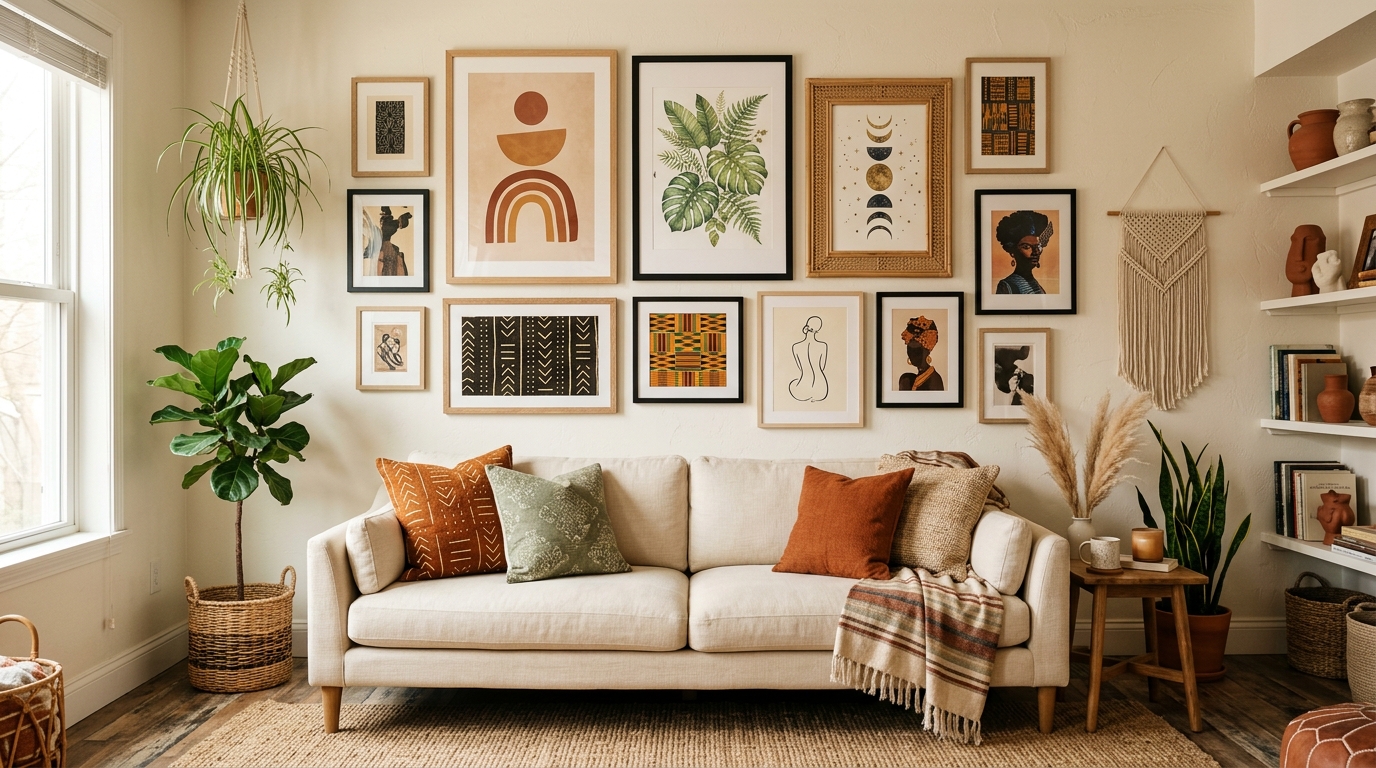
Mixed sizes arranged in a dense, floor-to-ceiling or large-area grouping. Best for: maximalist, Afrohemian boho, and eclectic styles. The most forgiving layout for imperfect execution.
3. Horizontal Row
Three to five frames in a single horizontal line at the same center height. Best for: hallways, above a console, and above a bed. Clean and simple to execute.
4. Asymmetric Cluster
Mixed sizes arranged off-center with intentional imbalance. Best for: boho and eclectic styles. Requires a strong anchor piece (largest frame) and building outward from it.
5. Staircase
Frames arranged diagonally following the line of a staircase. Best for: stairwells and angled walls. Follow the stair angle with the center of each frame.
6. L-Shape
Frames arranged along two walls meeting at a corner. Best for: filling awkward corner spaces. Use consistent frame sizes for a cleaner look.
Step 3: Master Gallery Wall Spacing
Spacing is where most gallery walls succeed or fail. The rules are simple once you know them.
Standard spacing between frames: 2 to 3 inches between frames is the sweet spot for most gallery walls. Less than 2 inches feels cramped. More than 3 inches feels disconnected.
Consistent vs. varied spacing: For grid layouts, keep spacing identical in all directions. For salon and asymmetric layouts, aim for consistent spacing as a starting point but allow for slight variation to fit the arrangement naturally.
The paper template method (how to avoid extra holes):
- Trace each frame on brown paper or newspaper and cut out
- Mark the hanging point on each paper template
- Tape templates to the wall with painter’s tape and adjust until the arrangement looks right
- Hammer nails through the marked hanging points on the templates
- Remove paper and hang frames
This method takes an extra 30 minutes and saves hours of filling unnecessary holes.
For a printable spacing guide with layout templates ready to trace, download the Free Wall Art Spacing Guide.
💡 Before you buy prints or frames:
Use the Free Wall Art Size Visualizer to see exactly how different art sizes look on your wall. Upload a photo of your space and visualize multiple layouts before spending anything.
Step 4: Mix Frames Without Creating Chaos
Mixing frame styles, sizes, and materials is what gives a gallery wall personality. But it needs a unifying principle or it looks accidental rather than curated.
The rules for mixing frames successfully, based on the principles of visual balance in interior design:
Rule 1: Maximum two metal finishes
You can mix matte black with natural wood, or brass with white. But mixing matte black, brass, silver, and rose gold in one arrangement creates visual noise. Pick two and stick to them.
Rule 2: Consistent mat color
If you are using matted prints, keep the mat color the same across all frames – typically white or off-white. This creates a visual thread that ties mixed frame styles together instantly.
Rule 3: Vary frame size, not style
If you are new to mixing frames, start by varying only the size (small, medium, large) while keeping the frame style consistent (all black, or all natural wood). Once you are comfortable, introduce a second frame style as an accent.
Rule 4: Anchor with your largest piece
Place your largest or most visually dominant piece first. Everything else arranges around it. The anchor piece should sit slightly left or right of center for an asymmetric arrangement, or dead center for a symmetric one.
Rule 5: Odd numbers feel more natural
Groups of 3, 5, 7, or 9 frames feel more organic and less rigid than even numbers. This is a design principle that applies to almost every styling decision.
Step 5: Choose Your Art Style for 2026
The style of prints you choose matters as much as the layout and sizing. Here are the art directions performing best on Pinterest and in home decor searches in 2026:
Afrohemian Boho (Rising 80 Percent on Pinterest in 2026)
Warm earthy tones, bold geometric patterns, African-inspired motifs, terracotta, rust, deep green, and cream. Works beautifully in mixed-frame salon arrangements with natural wood and rattan frames. Shop StyleMyHaven’s Boho Wall Art collection for prints in this style.
Neo Deco (Rising 80 Percent on Pinterest in 2026)
Geometric art deco patterns, gold accents, deep jewel tones (emerald, sapphire, plum), and bold graphic lines. Works best in grid or horizontal row arrangements with gold or brass frames.
Scandi Minimalist (Consistently High Volume US Searches)
Black and white photography, simple botanical line drawings, abstract shapes in neutral tones. Works in grid arrangements with thin black or natural wood frames. Shop StyleMyHaven’s Scandi collection for prints in this style.
Celestial (Rising Fast in 2026)
Moon phases, star maps, sun and moon illustrations, and cosmic abstract art. Works across all frame styles and is particularly strong in nursery and bedroom applications.
Minimalist Abstract (Evergreen High Volume)
Soft color-field paintings, simple geometric abstracts, and neutral-toned brushstroke art. The safest choice for renters and anyone who wants art that works across multiple style directions. Shop StyleMyHaven’s Minimalist collection for prints in this style.
Step 6: Digital Art vs. Physical Prints – Which to Choose
For renters and budget-conscious decorators, digital art downloads offer significant advantages:
| Factor | Digital Download | Physical Print (pre-framed) |
|---|---|---|
| Cost | $3 to $15 per print | $30 to $150+ per piece |
| Speed | Instant download | 3 to 10 days delivery |
| Flexibility | Print any size needed | Fixed size |
| Quality control | Depends on your printer or print lab | Consistent |
| Best for | Budget galleries, trying styles, renters | Investment pieces, gifting |
For most renter gallery walls, a mix works best: 1 to 2 investment physical pieces as anchors, with digital downloads filling out the gallery in complementary styles.
For the complete guide to printing digital art at home including paper types, printer settings, and size recommendations, see : Digital Wall Art Guide.
🎁 Get the Perfect Frame Guide for $3
The Perfect Frame Guide covers every framing decision in one place: sizing charts, mat color pairing rules, mixing frame styles, where to print at home vs. a lab, and how to hang frames on any wall type including renter-safe methods.
Get the Perfect Frame Guide for $3
Renter-Specific Gallery Wall Tips
If you are renting, the gallery wall question is more complex. You cannot fill walls with nails freely without risking your deposit. Here are the renter-safe options:
- Adhesive picture hanging strips (Command brand): Rated for 4 to 16 pounds per strip depending on size. Suitable for lightweight frames. Remove cleanly by pulling the tab slowly downward. Always check the weight rating before hanging.
- Leaning frames: For large statement pieces, lean frames against the wall on a shelf, console, or mantel. No wall contact at all.
- Gallery shelf ledges: Install tension-mounted or freestanding shelf ledges and lean frames on them. Swappable, moveable, and zero wall damage.
- Adhesive hooks with weight ratings: For very lightweight prints in frames under 1 pound, adhesive hooks work cleanly.
The rule for all renter wall hanging: weigh your frame before choosing your hanging method and never exceed the rated weight of your adhesive product.
Frequently Asked Questions
How far apart should gallery wall frames be?
The standard spacing between frames in a gallery wall is 2 to 3 inches. This applies between all frames in the arrangement regardless of their sizes. For grid layouts, keep spacing identical in both horizontal and vertical directions. For salon and asymmetric arrangements, aim for consistent spacing but allow slight variation where the arrangement requires it. Download the Free Wall Art Spacing Guide for printable layout templates that make measuring easier.
What size art should I choose for above a sofa?
Art or a gallery arrangement above a sofa should cover 57 to 75 percent of the sofa width. For a standard 84-inch sofa, that means art or a grouping 48 to 63 inches wide. Leave 6 to 8 inches of space between the top of the sofa and the bottom of the lowest frame. Use the Free Wall Art Size Visualizer to confirm sizing for your specific sofa and wall dimensions before purchasing.
How do I hang a gallery wall without damaging my rental walls?
Use Command adhesive picture hanging strips rated for the weight of your frames. Lightweight frames under 4 pounds work well with standard strips. For heavier frames, use multiple strips or switch to leaning frames on shelf ledges. Always remove adhesive strips by pulling the tab straight down slowly rather than pulling outward. Test one strip in an inconspicuous spot for 48 hours before committing to the full arrangement.
What makes a gallery wall look cohesive instead of messy?
A cohesive gallery wall has at least one unifying element across all pieces. The most effective unifiers are: consistent mat color (all white or all cream mats), consistent frame finish (all black, or all natural wood), a shared color palette in the prints (all warm tones, or all neutrals), or a consistent subject matter (all botanicals, all abstract, all photography). You do not need all four – even one strong unifying element is enough to make a mixed arrangement feel intentional.
You might also like:
- Renter-Friendly Home Decor Guide – style every room without risking your deposit
- Free Wall Art Size Visualizer
- Free Wall Art Spacing Guide
- Shop All Wall Art
- Boho Wall Art Collection
- Scandi Wall Art Collection
- Minimalist Wall Art Collection
- Browse All Freebies