

Hiring the wrong contractor is one of the most expensive mistakes a homeowner can make. Projects go over budget, timelines stretch from weeks to months, work quality falls short of what was promised, and in the worst cases the contractor disappears mid-project with a significant deposit in hand.
Knowing how to hire a contractor correctly – before you sign anything or hand over a dollar – is the single most valuable skill in home renovation. These 10 steps cover everything from finding candidates to signing a contract that actually protects you.
For the complete renovation planning framework this post sits within, see the Home Renovation Planning Guide 2026.
Why Most Homeowners Hire the Wrong Contractor
The most common hiring mistake is not negligence – it is urgency. A homeowner has a renovation they want done, they get one or two quotes, they pick the lowest or the most available, and they start. No vetting, no contract review, no red flag check.
The result is predictable. The low quote expands with change orders. The available contractor was available because better clients passed on them. And without a solid contract, there is no recourse when things go wrong.
The 10 steps below are designed to slow the process down just enough to make the right decision – without adding weeks of unnecessary delay.

10 Proven Steps for How to Hire a Contractor
Step 1. Define Your Scope Before You Contact Anyone
Before reaching out to a single contractor, write down exactly what you want done. Not “renovate the kitchen” – but a specific list: remove existing cabinets, install new cabinets, replace countertop, install new backsplash, repaint walls, replace sink and faucet. The more specific your scope, the more accurate and comparable your quotes will be. Vague scopes produce vague quotes that expand unpredictably once work begins.
Use the Free Room Material Calculator to get exact material quantities before your first contractor meeting – it removes guesswork from your scope document and signals to contractors that you are an informed client.
Step 2. Get a Minimum of 3 Quotes
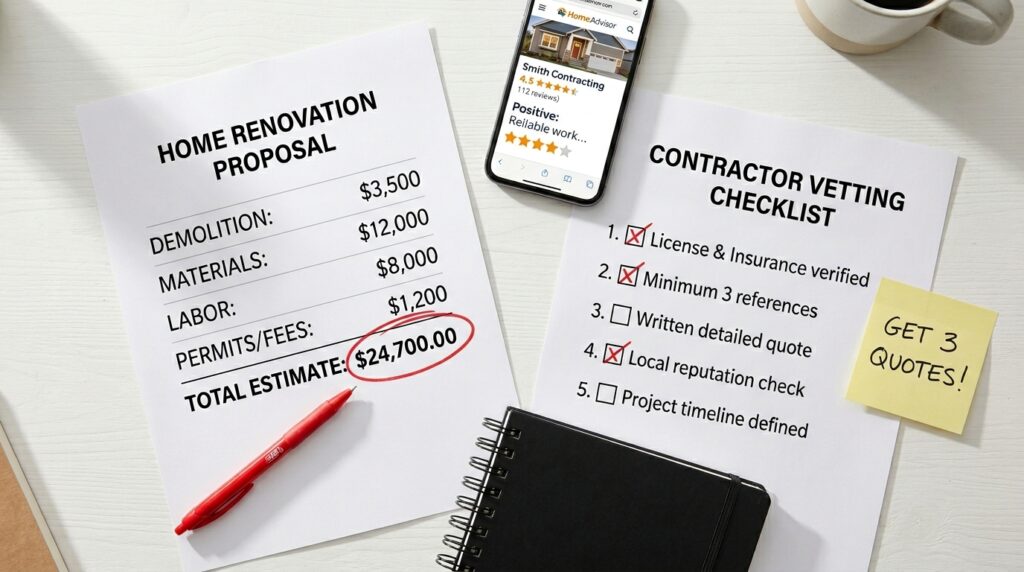
Never hire from a single quote. Get at least three from contractors who have reviewed the same written scope. This gives you a realistic price range, reveals outliers (both suspiciously low and unusually high), and creates competitive pressure that often improves the final terms. If only one contractor responds or is available, treat that as a yellow flag and keep looking.
Step 3. Verify License and Insurance Before the Meeting
Before you meet any contractor in person, verify two things independently:
- License – check their contractor license is valid and current at contractors-license.org
- Insurance – ask for a Certificate of Insurance showing general liability and workers compensation. Call the insurer directly to confirm it is active
An unlicensed or uninsured contractor exposes you to full liability for any injury on your property and leaves you with no regulatory recourse if work is substandard. This step takes 10 minutes and eliminates a significant category of risk.
Step 4. Check References – Actually Call Them
Ask every contractor for three recent references from projects similar in scope and budget to yours. Then call them – do not just collect the names. Ask specifically: Did the project finish on time? Did the final cost match the quote? Would you hire them again? How did they handle problems when they arose? One honest reference call tells you more than any online review.
Step 5. Review Online Reviews With Context
Check Google, Yelp and Houzz reviews but read critically. Look for patterns rather than individual ratings – multiple mentions of poor communication, scope creep, or no-show subcontractors matter more than one five-star and one one-star review. A contractor with 15 reviews averaging 4.2 is more informative than one with 3 reviews averaging 5.0.
Step 6. Meet on Site Before Committing
A reputable contractor will always want to see the job site before providing a final quote. Be wary of any contractor who quotes from photos alone or over the phone without a site visit for anything beyond the most minor jobs. The site meeting also tells you a lot – do they arrive on time, ask detailed questions, take measurements, and listen carefully to what you want?
Step 7. Understand the Quote Line by Line
A professional quote should itemise labour and materials separately. It should list specific products by brand and grade where relevant – not just “countertop” but “30mm laminate countertop, brand X, colour Y.” Vague line items like “miscellaneous materials” or “allowances” are where budgets expand. Ask for clarification on every line you do not understand before signing.
Step 8. Know the Red Flags – Walk Away From These
These are the contractor behaviours that most reliably predict a problem project:
- Demands more than 30% upfront – a deposit of 10 to 30% is standard. More than 30% before work starts is a red flag, especially on larger projects
- No written contract – verbal agreements are unenforceable. Always get everything in writing
- Unusually low quote – a quote significantly below all others usually means cut corners, inferior materials, or a plan to recover the margin through change orders
- Pressure to decide immediately – legitimate contractors do not use high-pressure tactics. Urgency is a manipulation technique
- No fixed business address – a contractor with only a mobile number and no verifiable business address has no accountability if things go wrong
- Wants cash only – no legitimate contractor should insist on cash-only payment for a significant project
Step 9. Get a Proper Written Contract
Before any work starts, your contract must include at minimum:
- Full scope of work in writing – exactly what is and is not included
- Total price and payment schedule tied to project milestones, not calendar dates
- Start date and estimated completion date with a delay clause
- Change order process – any scope change must be agreed in writing before work proceeds
- Materials specification – brands, grades and quantities where relevant
- Warranty terms on both labour and materials
- Dispute resolution process
Do not sign anything that is missing these elements. A contractor who resists a proper written contract is telling you something important.
Step 10. Stage Payments Against Milestones
Never pay ahead of work completed. Structure your payment schedule so each payment is released when a specific, verifiable milestone is reached – not on a calendar date. For example: 20% on signing, 25% when demolition is complete and materials delivered, 25% when rough work is done and inspected, 20% on practical completion, 10% retained for 30 days after completion to cover any defects. This structure protects you throughout the project and maintains your leverage if problems arise.
The Hidden Traps Most Homeowners Miss
Even after following all 10 steps, these are the situations that derail otherwise well-planned renovations:
- Permit requirements – some renovation work legally requires a permit. Your contractor should advise you on this. Unpermitted work can cause problems when you sell and may not be covered by insurance
- Subcontractors – many contractors use subcontractors for specialist work. Ask who will actually be doing the work and confirm subcontractors are also licensed and insured
- Scope creep – small additions that seem minor in isolation compound quickly. Use the change order process rigorously for every addition, no matter how small
- Material substitution – if specified materials become unavailable, insist on written approval of any substitution before it is installed
For a complete guide to the 20 hidden renovation traps that cause most budget overruns, the Renovation Survival Checklist covers every scenario in detail – $7.
Not Sure Where to Start With Your Renovation Budget?
Download the free Renovation Styling Checklist – a pre-start planning framework covering the sequence, preparation and material ordering steps before any work begins. Free with email signup.
Ready to go deeper? The Renovation Survival Checklist – $7 – covers the 20 hidden traps that cause most renovation budget overruns, including the contractor red flags, permit pitfalls and scope creep triggers that derail projects after they start.
Also in the planning phase? See the Home Renovation Planning Guide 2026 for the complete budget, timeline and room-by-room planning framework.
Frequently Asked Questions
How much should a contractor charge upfront?
A deposit of 10 to 30% of the total project cost is standard and reasonable. For smaller projects under $5,000, a flat deposit of $500 to $1,000 is typical. Any request for more than 30% before work begins is a red flag – especially on larger projects. Structure remaining payments against completed milestones, not calendar dates.
What is the biggest mistake people make when hiring a contractor?
Getting only one quote and hiring on availability or lowest price without vetting. The combination of no competitive comparison and no reference check is the most reliable predictor of a problem project. Always get three quotes, always call at least two references, and always verify license and insurance independently before meeting.
Do I need a written contract for a small renovation job?
Yes – for any job over $1,000, a written contract is essential. Verbal agreements are almost impossible to enforce and leave you with no recourse if the work is substandard or the contractor does not finish. A simple one-page document covering scope, price, payment schedule and completion date is sufficient for smaller jobs.
How do I know if a contractor’s quote is fair?
Get three quotes for the same written scope and compare them line by line. A fair quote falls within the mid-range of the three – not the lowest and not the highest. If one quote is significantly lower than the others, ask specifically what is different: lower-grade materials, fewer labour hours, or subcontracted work that is not yet priced. The answer tells you whether the low quote is genuinely competitive or a risk.