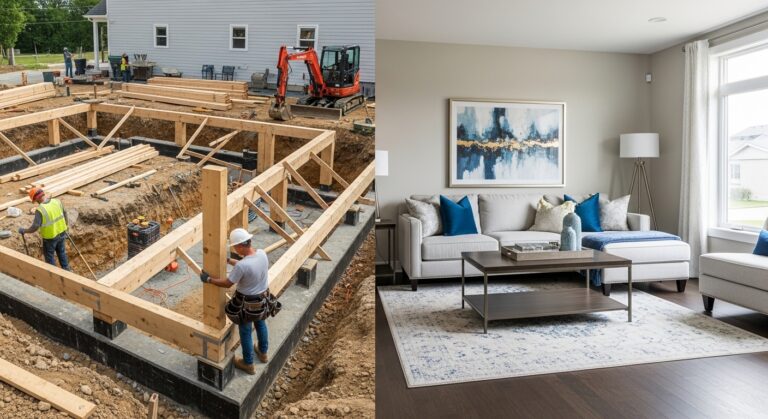

This home renovation planning guide covers everything you need to budget accurately, hire the right contractor, and finish your renovation on time and on budget in 2026.
Research consistently shows that the average US home renovation runs 20 to 30 percent over the original budget. For larger projects, overruns of 50 to 100 percent are not uncommon. The reasons are almost always the same:
- No contingency buffer – unexpected structural issues, permit delays, and material price changes hit every project
- Scope creep – small additions and upgrades add up faster than expected once work begins
- Poor sequencing – doing work in the wrong order means redoing finished work when earlier problems are discovered
- Underestimating labor – material costs are easy to research; labor costs vary dramatically by region and trade
- No written change order process – verbal agreements with contractors lead to disputed costs
How to Use This Home Renovation Planning Guide
Every section of this guide addresses at least one of these. By the end, you will have a planning framework that protects your budget from all five.
Step 1: Define Your Renovation Goals Before Anything Else

Before you get a single quote or visit a single showroom, write down your renovation goals clearly. This sounds obvious but most first-time renovators skip it and pay for it later.
Ask yourself these three questions:
- Why are you renovating? Comfort and lifestyle improvement, resale value increase, fixing a specific problem, or all three? Your answer changes which projects to prioritize.
- What does done look like? Be specific. Not “a better kitchen” but “a kitchen with new cabinets, a functional island, and updated lighting within a $25,000 budget.”
- What are your non-negotiables vs. nice-to-haves? Separating these protects you from scope creep when costs start climbing.
Write these down and keep them visible throughout the project. Every decision you make should be filtered through them.
Step 2: Set a Realistic Budget with a Proper Contingency
Budget-setting is where most renovation plans fail. The two most common mistakes are using online average costs without regional adjustment, and not building in a contingency buffer.
The baseline rule: Budget 10 to 15 percent of your home’s value for a major renovation. For a $300,000 home, that is $30,000 to $45,000 for a significant project.
The contingency rule: Always add 15 to 20 percent on top of your estimated project cost for unexpected expenses. This is not optional. Every experienced contractor and project manager will tell you the same thing. If you do not use it, you save it.
Regional cost adjusters: Labor and material costs vary significantly depending on location. In major US coastal markets-such as New York, San Francisco, and Seattle-renovation costs can run 25 to 40 percent above national averages. Conversely, Midwest and Southern regional markets often average 10 to 20 percent below. Always secure local contractor quotes to establish an accurate regional budget.
Budget Breakdown by Room (Mid-Range US Estimates 2026)
| Room | Budget Refresh | Mid-Range Remodel | Full Gut Renovation |
|---|---|---|---|
| Kitchen | $5,000 to $15,000 | $25,000 to $50,000 | $50,000 to $100,000+ |
| Bathroom | $3,000 to $8,000 | $10,000 to $25,000 | $25,000 to $50,000 |
| Living Room | $2,000 to $5,000 | $8,000 to $20,000 | $20,000 to $40,000 |
| Bedroom | $1,500 to $4,000 | $5,000 to $15,000 | $15,000 to $30,000 |
| Full House | $20,000 to $50,000 | $80,000 to $150,000 | $150,000 to $400,000+ |
These are starting frameworks, not fixed quotes. Your actual costs depend on location, material choices, and project complexity.
💡 Before ordering any materials, use the free tool that prevents overbying:
The Free Room Material Calculator calculates exact quantities of paint, flooring, and wallpaper for any room size. Enter your dimensions and get instant results. No math, no waste, no costly overordering.
Step 3: Understand the Correct Renovation Sequence
One of the most expensive mistakes in renovation is doing work in the wrong order. When sequence is wrong, finished work gets damaged or redone. Here is the correct order for any major renovation:
- Planning and permits – Submit all permit applications before starting. Structural, electrical, and plumbing work almost always requires permits in the US.
- Demolition – Remove what needs to go before anything new goes in.
- Structural work – Foundation repairs, load-bearing walls, roof work. Always first.
- Rough mechanical work – Plumbing, electrical, and HVAC behind the walls.
- Inspections – Get rough work inspected and signed off before closing walls.
- Insulation and drywall – Seal and close the walls.
- Painting and flooring – Paint before flooring to protect new floors from drips.
- Cabinets, countertops, and fixtures – Install kitchen and bathroom fittings.
- Finish electrical and plumbing – Connect outlets, switches, faucets, and light fixtures.
- Final touches and styling – Trim, hardware, decor, and clean.
Skipping or reordering any of these steps is where cost overruns are born. If your contractor suggests a different sequence without a clear reason, ask why before agreeing.
Step 4: Build Your Renovation Timeline
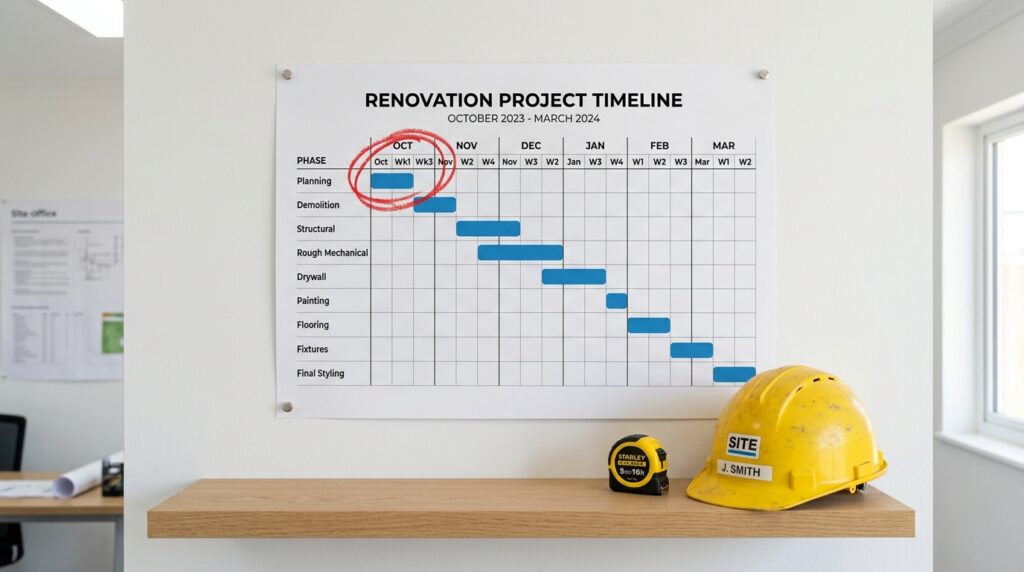
Renovation timelines are almost always underestimated. Here are realistic timeframes for common projects:
| Project | Realistic Timeline |
|---|---|
| Single bathroom remodel | 3 to 6 weeks |
| Kitchen remodel (mid-range) | 6 to 12 weeks |
| Full kitchen gut renovation | 12 to 20 weeks |
| Single room addition | 3 to 4 months |
| Whole house renovation | 6 to 12 months |
Three timeline killers to plan for:
- Permit delays – In many US cities, permit approvals take 2 to 6 weeks. Apply early and factor this into your start date.
- Material lead times – Custom cabinets, specialty tiles, and imported fixtures can have 8 to 16 week lead times in 2026. Order early.
- Contractor scheduling – Good contractors are booked 4 to 8 weeks out. Do not wait until you are ready to start before contacting them.
Build these delays into your timeline from day one rather than treating them as surprises.
Step 5: Find and Manage Contractors
Hiring the wrong contractor is the fastest way to turn a renovation into a nightmare. Here is a practical framework for hiring well:
Getting quotes:
- Get a minimum of three written quotes for any project over $5,000
- Quotes should itemize labor and materials separately
- Be suspicious of quotes significantly lower than the others – they usually mean corners will be cut
Vetting contractors:
- Verify license and insurance in your state before signing anything
- Ask for references from projects completed in the last 12 months and actually call them
- Check reviews on Google, Houzz, and the Better Business Bureau
- Never pay more than 10 to 30 percent upfront as a deposit
Managing the relationship:
- Put everything in writing including change orders
- Agree on a communication schedule (weekly progress updates minimum)
- Do not make final payment until you have done a punch list walkthrough and signed off on all completed items
Step 6: The 20 Hidden Renovation Traps
This is what nobody tells first-time renovators. These are the traps that turn a $30,000 project into a $60,000 disaster:
- Skipping the professional inspection before budgeting
- Not pulling permits (and having to redo finished work to pass inspection)
- Choosing materials before confirming lead times
- Hiring the cheapest contractor without checking references
- Not having a written contract with payment milestones
- Agreeing to verbal change orders instead of written ones
- Starting cosmetic work before structural issues are resolved
- Forgetting to budget for temporary accommodation during major works
- Not sequencing trades correctly (leading to rework)
- Ordering exact material quantities with no buffer for cuts and wastage
- Ignoring asbestos and lead paint testing in pre-1980 homes
- Not testing peel-and-stick or adhesive products on small patches first
- Paying the final contractor payment before the punch list is signed off
- Underestimating the cost of disposal and skip hire
- Not protecting finished surfaces during ongoing work
- Forgetting about permit final inspections before move-in
- Choosing trendy materials over timeless ones for high-cost permanent installations
- Not factoring in the cost of living elsewhere during the renovation
- Assuming your DIY skills cover tasks that actually require licensed tradespeople
- Starting without a clear written scope of work document
📋 Do not start your renovation without this:
Download the Free Renovation Styling Checklist – a practical pre-start checklist that walks you through every planning step before work begins. Free, instant download.
🎁 Want the complete renovation protection system?
The Renovation Survival Checklist covers all 20 hidden traps in detail with action steps for each one. Everything your contractor will not tell you, for just $7.For the full planning, budgeting, and execution system including editable templates, contractor scripts, and a room-by-room cost tracker, get the Renovation Mastery Toolkit for $45.
Step 7: Calculate Materials Before You Buy
Material waste is one of the most avoidable renovation costs. Overordering is expensive. Underordering causes delays when you need a second delivery. The solution is accurate calculation before purchasing.
Standard waste buffers to add:
- Paint: add 10 percent for touch-ups and second coats
- Tiles: add 10 to 15 percent for cuts, breakage, and pattern matching
- Flooring: add 10 percent for cuts and future repairs
- Wallpaper: add one extra roll per room for pattern matching and errors
Use a calculator instead of guessing:
The Free Room Material Calculator calculates exact paint, flooring, and wallpaper quantities for any room dimensions. Use it before every purchase to avoid costly over or underordering.
If you are decorating a rental while planning your renovation, the Renter-Friendly Home Decor Guide covers damage-free styling for every room.
Save vs. Splurge: Where to Spend and Where to Cut
Not every renovation dollar carries equal return. Here is where experienced renovators spend and where they save:
| Category | Verdict | Reason |
|---|---|---|
| Structural and waterproofing | Always splurge | Cheap work here costs 10x to fix later |
| Electrical and plumbing | Always splurge | Safety and code compliance are non-negotiable |
| Kitchen cabinets | Splurge on boxes, save on doors | Cabinet boxes last 20+ years; doors can be replaced |
| Countertops | Splurge if budget allows | High-use surface that defines kitchen quality perception |
| Tiles | Mid-range sweet spot | Very cheap tiles look cheap; expensive tiles rarely add proportional value |
| Paint | Splurge on quality | Cheap paint means more coats and faster fading |
| Fixtures and hardware | Save | Affordable options look identical to expensive ones in photos |
| Appliances | Mid-range | Reliability matters more than brand prestige |
| Decor and styling | Save | This is where DIY and budget sources shine |
2026 Renovation Trends Worth Building Around
These are the renovation directions gaining momentum in 2026 that have lasting design value rather than short shelf lives:
- Timeless over trendy for permanent installations – Neutral cabinetry, classic tile formats, and quality materials that will not date within five years
- Biophilic design integration – Natural materials, indoor plants, and connections to outdoor spaces built into the renovation plan
- Energy efficiency upgrades – Insulation, double-glazed windows, and efficient HVAC are trending because they reduce ongoing costs and increase resale value
- Multi-functional spaces – Home offices, guest rooms, and flex spaces built into renovation plans rather than added later
- Smart home infrastructure – Wiring for smart lighting, security, and automation during renovation is far cheaper than retrofitting
Frequently Asked Questions
Where do I start when planning a home renovation?
Start with three things before anything else: write down your goals clearly, get a professional inspection to understand what needs fixing structurally, and set a realistic budget with a 15 to 20 percent contingency buffer built in. Only after these three are done should you start getting contractor quotes or choosing materials.
How do I avoid going over budget on a renovation?
The most effective protections are: a written scope of work before work starts, a written change order process for any additions, a 15 to 20 percent contingency buffer in your budget, and accurate material calculations using a tool like the Free Room Material Calculator before purchasing. Most budget overruns are caused by scope creep and unplanned surprises that a proper inspection and contingency buffer would have covered.
What order should I renovate rooms in?
Start with rooms that have structural or functional issues such as a leaking bathroom or damaged kitchen. Then move to high-impact areas that increase daily quality of life and resale value – kitchens and bathrooms first, then living areas and bedrooms. Leave purely cosmetic rooms like home offices and guest rooms for last.
How do I find a reliable contractor in the US?
Get a minimum of three written quotes, verify license and insurance in your state, check references from the last 12 months, and review their Google and Better Business Bureau ratings. Never hire based on price alone. The cheapest quote almost always means the most expensive outcome.
You might also like:
- Free Room Material Calculator
- Free Renovation Styling Checklist
- What Comes First When Renovating a House
- How Much Does It Cost to Fully Renovate a House
- Browse All Free Tools