
This room material calculator guide shows you exactly how to calculate paint, flooring and wallpaper quantities before you buy a single item – so you never overbuy again.
I wasted $800 on excess flooring because I miscalculated my bedroom renovation. I bought 15 boxes when I needed 11, and the return policy? Non-refundable after opening two boxes. That expensive mistake sat in my garage for two years before I finally gave it away.
But here’s what changed everything: I discovered a free tool that does the math in 30 seconds—and it automatically accounts for the hidden factors that trip up 90% of DIYers. The Room Material Calculator has since saved me (and thousands of homeowners) from expensive over-buying and the nightmare of under-buying mid-project.
The 3 Costly Material Mistakes Draining Your Budget
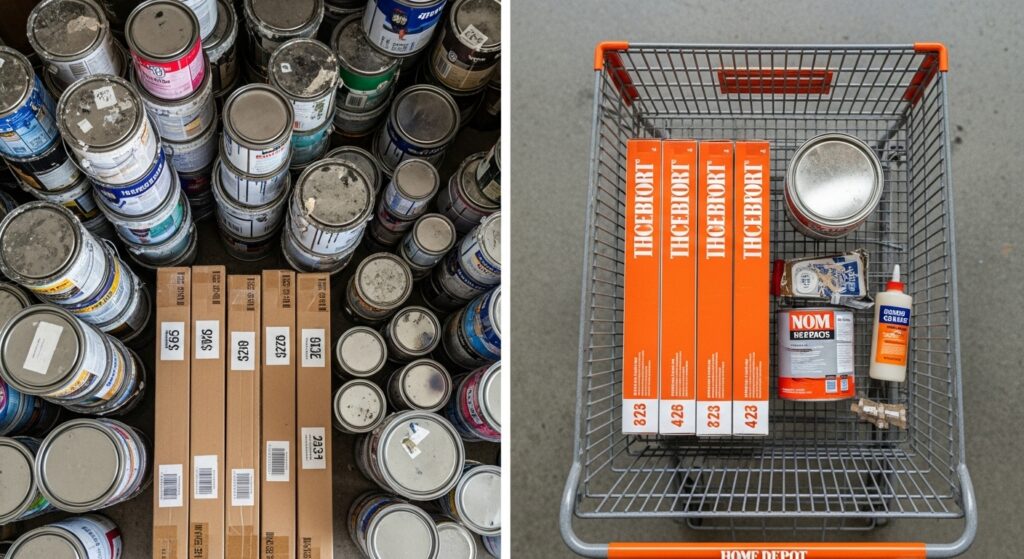
The Over-Buy Trap: Wasted Money Sitting in Storage
Homeowners routinely overestimate material needs, spending hundreds on extra boxes of flooring or gallons of paint that never get used. The construction industry generates staggering waste—Australia alone risks wasting $64 billion in building materials over five years, with the average project discarding 141 kilograms of material per square meter. For home renovators, this translates to cluttered garages full of unopened supplies and zero return on investment.
Material waste isn’t just an environmental issue—it’s money directly out of your pocket. Studies show that 22% of materials used in typical construction projects never make it into the final building, costing owners an estimated $52,000 per apartment in commercial settings. While residential projects operate at smaller scales, the waste percentage remains alarmingly high.
The Under-Buy Nightmare: Project Delays and Mismatched Materials
Running out of paint or flooring halfway through a project creates expensive problems. Dye-lot variations mean your “same color” paint from a second purchase may not match perfectly. Flooring manufacturers change finishes between production runs, making it nearly impossible to match discontinued products. One HomeCalc Pro analysis revealed that installers should always purchase all flooring at once and keep extra boxes for future repairs, as “dye lots and finishes will change”.
The time cost compounds the financial damage. Waiting for back-ordered materials can stall projects for weeks, extending contractor labor costs or leaving your home in renovation chaos longer than planned. Professional installers report that material shortages are among the top three causes of project delays.
The Geometry Headache: Manual Calculations Gone Wrong
Calculating floor area feels straightforward, but wall surface area becomes complex when accounting for multiple windows and doors of different sizes. Most homeowners forget to subtract these openings, leading to over-purchasing. Even more commonly overlooked: the mandatory 10% waste buffer for flooring cuts and the fact that walls almost always require two coats of paint.

Industry standards from organizations like the Painting and Decorating Contractors of America (PDCA) recognize two coats as the performance benchmark, as paint manufacturers formulate their products to reach optimal thickness only after two applications. Single-coat coverage delivers just 1.5 mils of dry film thickness, while two coats achieve 3-4 mils—doubling washability, adhesion, and fade resistance.
The Smart Solution: Room Material Calculator
The Room Material Calculator eliminates guesswork with professional-grade estimates in under 30 seconds—no math required. This browser-based tool uses contractor-approved formulas to calculate exactly what you need for paint, flooring, and wallpaper, automatically incorporating industry best practices that typical online calculators miss.
Unlike basic square-footage calculators, the Room Material Calculator applies real-world logic that reflects how professional contractors actually estimate jobs. The tool is completely free, requires no sign-up or email capture, and works instantly on mobile or desktop devices. Whether you’re a DIY homeowner planning a weekend bedroom makeover or an independent contractor providing quick quotes during site visits, the calculator delivers contractor-ready outputs that serve as shopping lists or client estimates.
The calculator has helped thousands of users avoid the twin disasters of over-buying and under-buying, with one user reporting: “I thought I needed 12 gallons of paint for my living room. The Room Material Calculator calculated 7 gallons—accounting for two coats and my large windows. That’s $125 saved in 30 seconds.”
Step-by-Step: How to Use the Material Calculator
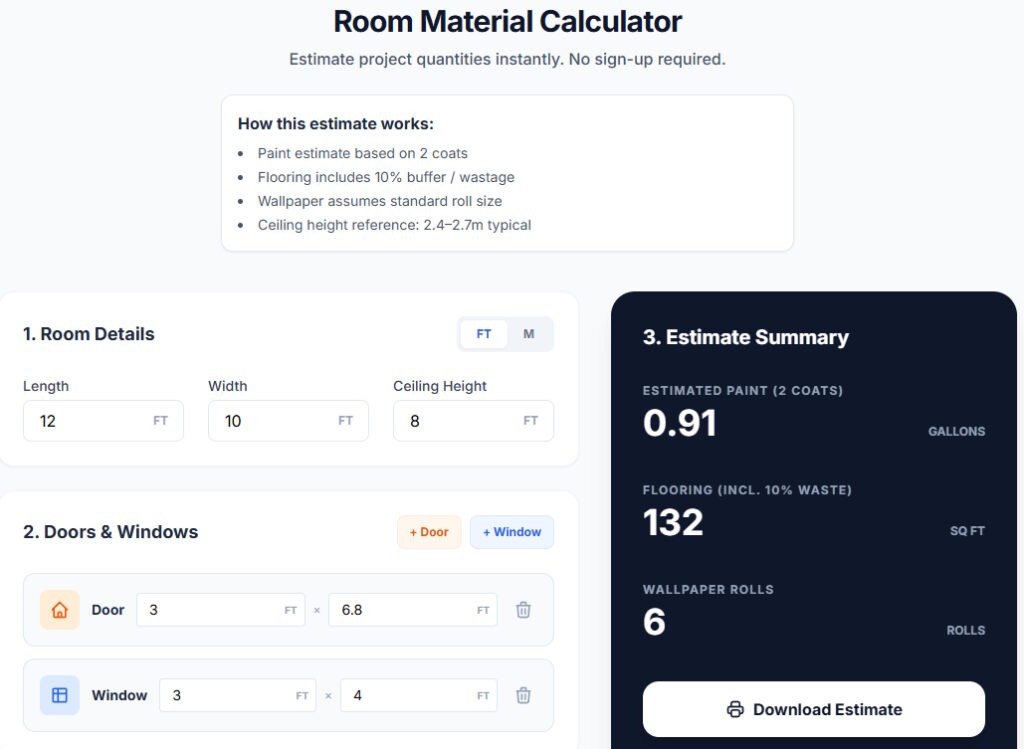
Step 1: Measure Your Room Dimensions
Start by measuring your room’s length and width using a tape measure or laser measuring tool. For irregularly shaped rooms, break the space into rectangular sections and calculate each separately. Record measurements in feet for consistency. Most homeowners already have basic dimensions from floor plans, but verify these measurements as “as-built” dimensions often differ from architectural drawings.
Pro tip: Measure at floor level rather than estimating from ceiling dimensions, as walls may not be perfectly perpendicular.
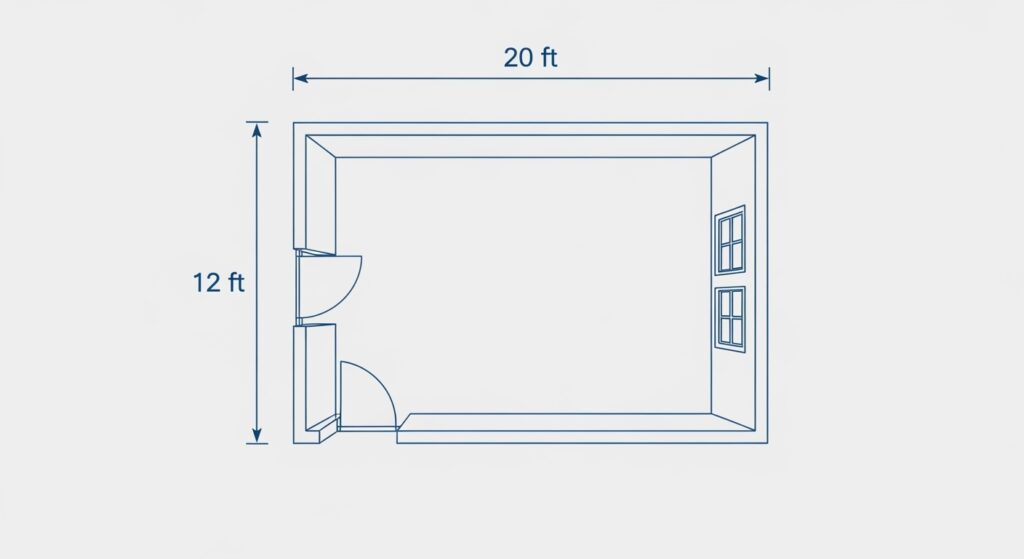
Step 2: Enter Door and Window Sizes
Measure the width and height of each door and window opening. The calculator subtracts these from your total wall area to prevent you from buying paint or wallpaper for glass surfaces. Enter each opening individually for maximum accuracy—don’t average or combine different-sized windows.
Standard door sizes typically measure 36 inches wide by 80 inches tall, while window sizes vary dramatically. If you have multiple identical windows, enter the dimensions once and specify the quantity.
Step 3: Get Instant Estimates for Paint, Flooring, and Wallpaper
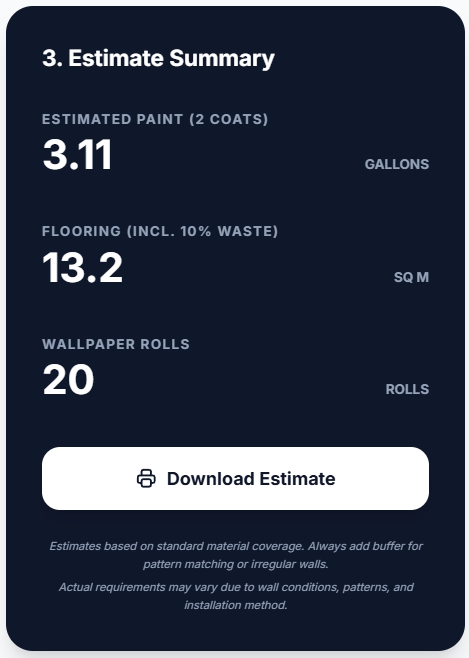
After entering your measurements, the Room Material Calculator generates immediate estimates for all three material types. The paint calculation automatically factors in two-coat coverage—the professional standard that ensures color accuracy, durability, and uniform sheen. Premium paint brands like Sherwin-Williams Emerald® and Benjamin Moore Aura® are formulated to reach full performance only after two coats.
For flooring, the tool adds a 10% waste buffer for standard straight-lay installations—the industry-recommended allowance for cuts, mistakes, and future repairs. Diagonal patterns or complex layouts may require 15-20% waste factors, which professional installers often adjust manually.
Wallpaper calculations account for standard roll sizes and pattern matching, preventing the common mistake of ordering insufficient rolls for designs that require alignment.
Download Your Professional Estimate
Click “Download Estimate” to generate a clean PDF summary that works as a shopping list for home improvement stores or an attachment for contractor proposals. The document itemizes each material type with precise quantities, allowing you to compare prices across retailers or present clients with transparent quotes.
Professional contractors report that this feature alone saves 15-20 minutes per estimate, allowing them to provide on-the-spot quotes during initial consultations without returning to the office for calculations.
Industry Secrets Built Into the Calculator
The 10% Waste Rule for Flooring
Professional installers universally apply a 10% waste factor for straight-installation patterns in simple rooms. This buffer accounts for cutting around obstacles, occasional mistakes, and the reality that flooring comes in fixed-size planks or tiles that won’t perfectly divide into your room’s dimensions. HomeCalc Pro recommends that “the general rule is to add 10% for installations with less than 1,000 square feet of material and 7% for installations requiring more than 1,000 square feet”.
For diagonal, herringbone, or chevron patterns, waste increases dramatically to 15-20%. DIY installers should add an extra 5% beyond these baselines for learning curve mistakes, bringing total waste factors to 15-20% for complex installations.
The 2-Coat Paint Standard
Two coats of paint aren’t optional—they’re engineered into the product. Manufacturers like Sherwin-Williams, Benjamin Moore, and PPG formulate their coatings to achieve proper dry film thickness (DFT) only after two applications. One coat typically produces just 1.5 mils of DFT, while two coats reach 3-4 mils, doubling washability and extending lifespan from 2-3 years to 6-10 years.
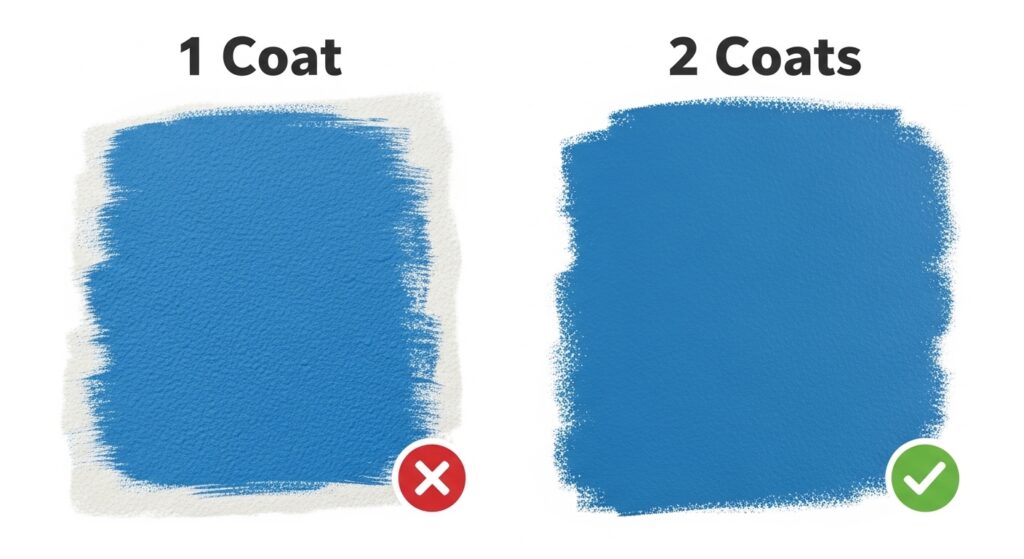
Professional painting standards from PDCA and MPI (Master Painters Institute) recognize two coats as the benchmark for both commercial and residential work. The Room Material Calculator automatically factors this into every paint estimate, preventing the common DIY mistake of buying half the paint you actually need.
Precision Window and Door Deductions
Basic calculators often ignore openings or use rough averages, leading to 5-10% over-purchasing on paint and wallpaper. The Room Material Calculator’s precision deduction system subtracts each opening individually, ensuring you’re not buying materials for glass surfaces. For rooms with large windows or patio doors, this feature alone can save $50-$100 per room.
The calculator also accounts for trim and baseboards, areas that require paint but occupy minimal surface area compared to full walls.
Real-World Use Cases
Living Room Renovation: Combining Paint and Flooring
A 15′ × 20′ living room with two large windows and one doorway requires 2.5 gallons of paint (two coats) and 330 square feet of flooring (including 10% waste). Using the Room Material Calculator, homeowners can generate both estimates simultaneously, creating a comprehensive shopping list for Home Depot or Lowe’s. This scenario represents the most common DIY project, where accuracy directly prevents the over-buy trap that wastes $200-$400 on excess materials.
Pro contractors use this same calculation to provide instant quotes during consultations, impressing clients with immediate, professional estimates rather than vague “I’ll get back to you” responses.
Bedroom Makeover: Small Space Precision
A 12′ × 12′ bedroom with one window typically needs 1.5 gallons of paint and 160 square feet of flooring. Small spaces magnify calculation errors—over-buying by just one gallon represents a 67% waste for this room size. The calculator’s window deduction feature becomes especially valuable here, as that single 3′ × 5′ opening reduces paint needs by approximately 0.25 gallons.
For renters using peel-and-stick wallpaper for accent walls, precise calculations prevent ordering excess rolls that can’t be returned after opening. Check out the Renter-Friendly Makeover Guide for damage-free renovation strategies that work with precise material estimates.
Bathroom Renovation: Managing Multiple Small Spaces
Bathrooms present unique calculation challenges with multiple small walls, several openings (door, window, shower/tub area), and often ceiling painting requirements. A standard 8′ × 5′ bathroom might need just 0.75 gallons of paint but 60 square feet of flooring when calculated accurately. The under-buy nightmare hits hardest in bathrooms—running out of specialty tile mid-project often means waiting weeks for reorders, as bathroom tiles frequently have longer lead times than general flooring.
The Room Material Calculator handles these complex small-space calculations efficiently, and pairs perfectly with bathroom-specific styling advice from the Bathroom Makeover Cheat Sheet.
Start Saving Money Today
Stop gambling with renovation budgets and join thousands of homeowners who’ve eliminated material waste using the Room Material Calculator. The tool is completely free, requires no sign-up, and delivers professional-grade estimates in 30 seconds. Whether you’re planning a single-room refresh or a whole-home renovation, accurate material calculations form the foundation of budget-smart projects.
Calculate your materials now, then download the Renovation Survival Checklist to catch 20 hidden traps that could derail your project. This early-warning system includes the “Should I DIY or Hire?” worksheet that helps you avoid costly mistakes before they happen.
For comprehensive project planning with budget-protection tools, explore the Renovation Mastery Toolkit—featuring the “Budget Defender” system that prevents costs from tripling mid-project. Smart renovators combine precise material calculations with strategic planning to stay on budget and on schedule.
Ready to calculate? Try the Free Room Material Calculator right now and stop wasting money on guesswork.